Friday, 25 July 2014

A FORAY INTO PHOTOGRAPHY


Finding myself frustrated with the painting process. I decide to strip myself of the title 'painter' and replace it with 'artist'. This gives me a much freer feeling and 'permission' to investigate other mediums without having to think about them as preliminaries to painting. Other mediums/practices have always played a part within my work, but somehow I have always sidelined them as the other stuff I do when not painting. Now I am thinking about them as part of the extended range of my practice - different approaches needed to articulate and manifest my ideas.

The subject matter of memory, how it unfolds in and upon itself; it's fallibility, truths and falsehoods are still central to my practice. The use of landscape with its variable possibilities of journeys as a metaphor for memory is also its most poignant manifestation and where I feel most able to express these ideas/questions.


After Image: Inkjet Photograph on Archival Cotton Rag


The photography collages are running at the same speed as my pattern of thoughts. Ideas can be very quickly created, progressed or discarded.Starting with my own or found photographs I am using a mixture of collage, Photoshop, cutting, sticking and re-photographing.Being a novice to Photoshop, I am currently unencumbered with stifling knowledge and am embracing the 'accidents' of new explorations.

Reflecting: Inkjet Photograph on Archival Cotton Rag
The processes are mentally similar to the ones I engage in whilst painting, but the physical process is much faster allowing me a lot more room for experimentation.

I have begun to make little mock-up sets in which to manipulate the ideas.Cutting and sticking together different photos,adding props, lighting then re-photographing.Playing with what we see- real and perceived. Creating new 'memories' of places that never quite were.

The Hut:Inkjet Photograph on Archival Cotton Rag


Monday, 7 April 2014

DISSECTING LANDSCAPE

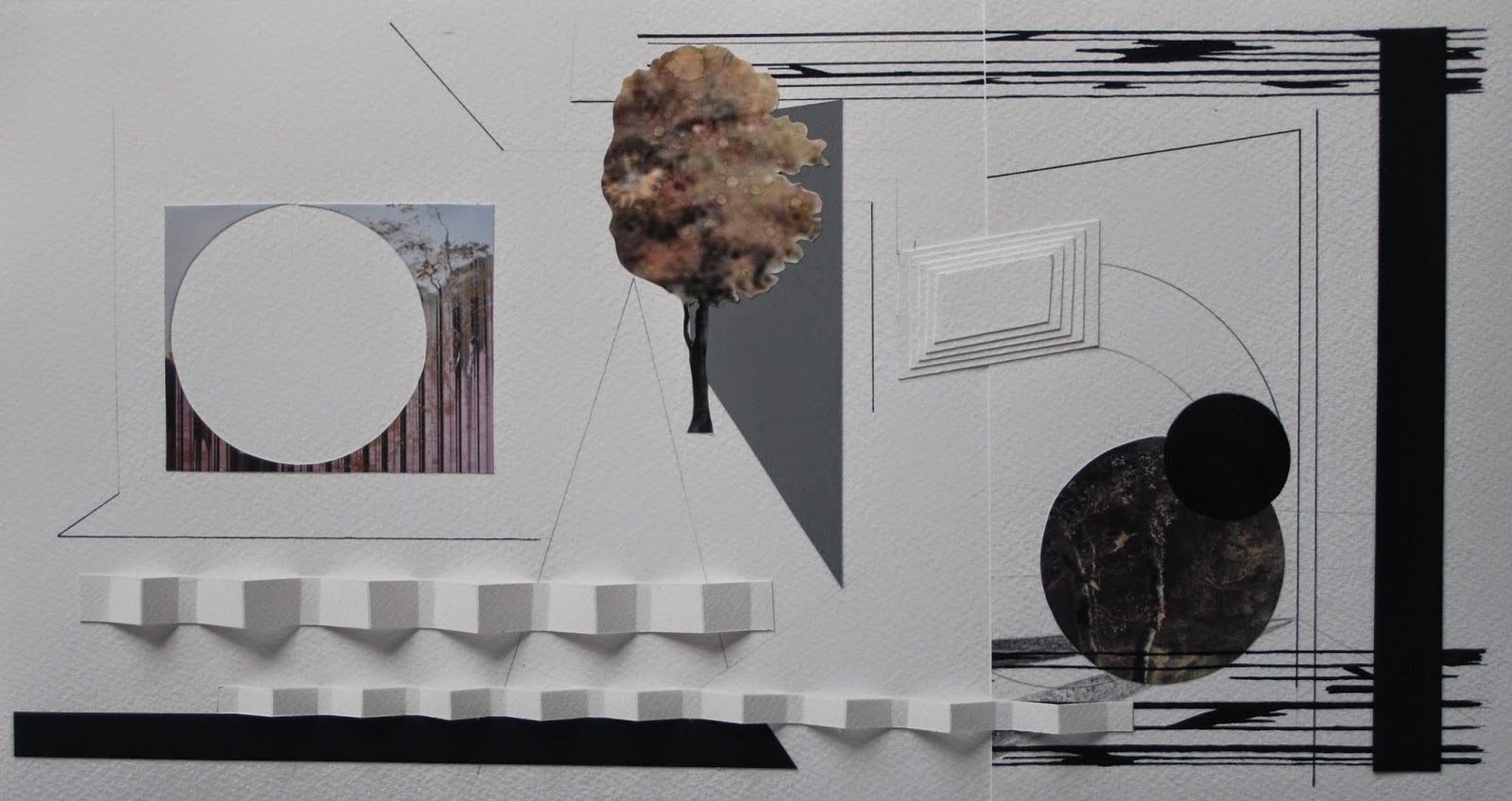
The collage is continuing. Playing with the world within world theme, perspective, depth paper folding.
The circular worlds are a mixture of painting, photographs of my paintings and images from Romantic landscape artists.The black circles have begun to represent voids. Voids in space and voids in memory. What is not there being as important as what is left.

Collage,pencil and acrylic on paper

When I remove the 'world' leaving an empty circle this appears to create more space. A view into another space. The eye fills in what has been removed. The folded zig-zags move physically across the space and pierce into actual space. This piece is moving between many planes, moving backwards and forwards, left and right.

Collage, pencil and acrylic on paper


I begin to add references to structures, to place architectural forms around the landscapes. Space and setting is more ambiguous.


Collage, pencil and acrylic on paper


Sunday, 2 March 2014

COLLAGE

Cutting, sticking and creating new worlds. The bubble worlds lead to more worlds within worlds. Working in a much more graphic seeming tight way actually opens up new spaces. The white of the paper has become important as part of the concept of space. 
I am mixing prints from the Dutch Italiante with prints from my own paintings. Cutting circles and laying onto the paper. Flatness and space playing with depictions of space and cutting through with black lines that interrupt and unite the layers of worlds. Black circles act as voids or blockages.

DISC WORLDS

Disc World (1)
Print, acrylic and pencil on paper.
30 x 40 cm

Disc World (2)
Print, acrylic and pencil on paper.
30 x 40 cm

Disc World (3)

 Print, acrylic and pencil on paper.
30 x 40 cm

Tuesday, 21 January 2014

THE CONTINUAL SEARCH


The landscape can be used to represent a space of the imagination into which we can project our own interpretations. Nature can stand for the ideal state from which we have come and with which, if we are to attain lasting happiness. This landscape is a juxtaposition of the tragedy and irreconcilable conflict of present situations and a place of escape.


The Continual Search
Oil on Canvas   120x150cm

UTOPIA/DYSTOPIA

The landscape can be used to represent a space of the imagination into which we can project our own interpretations. A landscape is able to show us both the tragedies and irreconcilable conflicts of our present situation, and it is also a place where we might escape. 

The landscape that I am most familiar with in England has been manufactured by man. It is a kind of reordering of nature in our own image and as such is a reflection of who we are.

Using recognizable images from art history, such as Constable, Claude Lorrain and Turner, along with more contemporary landscapes from Peter Lanyon, Paul Nash, Damien Flood (among others); I offer the viewer a sense of the familiar and then intermingle these with personal landscape narratives from memory. The layering of these appropriated images with my own morph together and become one.

The versatility of paint allows for areas of lucidity and fluid elusiveness. Moving between clarity and abstraction in much the same way as memory discloses itself; only revealing itself in the process of remembering.
I allow the painting to 'reveal' itself in the process of painting. One thing leads me to another. As memory emerges we think it will be one thing and then it can transform. Each time we re-remember we get a layering or folding. Different parts sticking together getting folded inside one another, fading and emerging. It appears that each time we remember something, our memory is permanently altered and as such there is no 'true' memory.

As I remember; images flood into my mind, with both good and bad associations, one image triggering another, as much as I can, I allow these memories into the painting, editing and adding in equal measure; until finally a composition settles.

Sifting Forms Returned
Oil on Canvas  45x35cm


LANDSCAPE


I must again repeat the necessity of keeping one’s mind open to that extreme nature with which we are surrounded, for few there are who seem aware of the beauty of the paradise in which we are placed. We exist in a landscape and we are the creatures of a landscape...’

John Constable, 1833


The Disproportionate Loss of Self in an Altered Landscape
Oil on Canvas   180x150cm